
Lahore Declaration 1999 India-Pakistan Relations
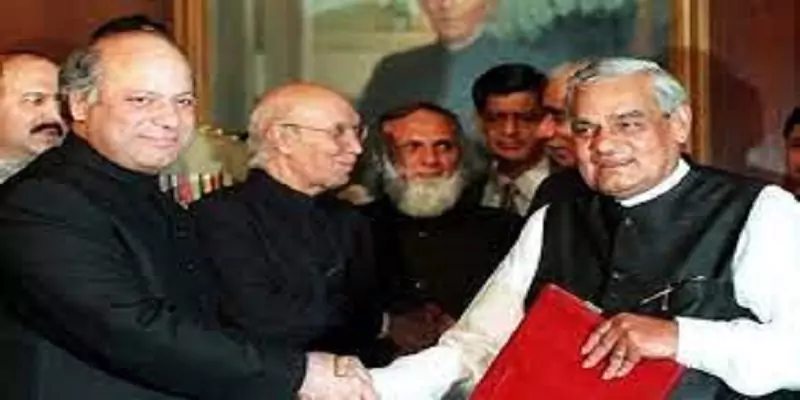
The Lahore Declaration was one of the most important attempts in the modern history of India-Pakistan relations to move towards peace and stability after decades of hostility. Signed on 21 February 1999, the agreement brought together the Prime Minister of India, Atal Bihari Vajpayee, and the Prime Minister of Pakistan, Nawaz Sharif, at a moment when both nations had already declared themselves nuclear powers following the nuclear tests of May 1998. The document symbolized not just a diplomatic handshake but an effort to address fears of nuclear escalation, open the doors for dialogue, and encourage economic and cultural cooperation.
To understand the significance of the Lahore Declaration, it is necessary to revisit the tense period leading up to it. In May 1998, India conducted a series of nuclear tests at Pokhran between the 11th and 13th of the month. These tests were a signal that India had formally joined the global nuclear club, and they were celebrated domestically as a demonstration of strength and technological achievement. However, they also sparked international criticism and created new security concerns in South Asia. Pakistan, unwilling to remain behind, responded within weeks by conducting its own nuclear tests at the Chagai Hills in Balochistan on 28 and 30 May 1998, known as Chagai-I and Chagai-II. This tit-for-tat move officially brought South Asia into the nuclear race, raising alarm about the possibility of future conflicts escalating into nuclear confrontations.
The nuclear rivalry intensified old hostilities. For decades, India and Pakistan had clashed over multiple wars, beginning with the partition of 1947, the conflict in 1965, and then the war of 1971 that resulted in the creation of Bangladesh. Following the 1971 war, both sides signed the Simla Agreement in 1972, committing to resolve disputes through peaceful means. Yet, the shadow of Kashmir and recurring border tensions never allowed relations to normalize fully. By the late 1990s, with both countries now nuclear-armed, the risk of any miscalculation turning into disaster grew too serious to ignore.
It was in this atmosphere of uncertainty that Nawaz Sharif invited Atal Bihari Vajpayee to Pakistan in early 1999. The Indian Prime Minister made the historic journey by road on a bus service that connected Delhi and Lahore, symbolizing a people-to-people link beyond the barbed wire of borders. Vajpayee was warmly welcomed by Sharif at the Wagah Border, and the atmosphere carried rare optimism. Prominent Indian cultural and political figures, including Dev Anand, Javed Akhtar, Satish Gujral, and Shatrughan Sinha, were part of the visit, underscoring that the effort was not just diplomatic but also culturally significant.
The discussions between the two leaders touched on the most pressing issues. Both acknowledged that nuclear capability had changed the security balance in South Asia and made it essential to avoid confrontation. They discussed ways to build trust, exchange information, and reduce risks of accidental conflict. Beyond nuclear security, they also explored possibilities for trade and economic cooperation, recognizing that both nations could benefit from stronger commercial ties. The Lahore Declaration emphasized that easing visa restrictions, expanding transport links, such as the Delhi-Lahore bus service, and addressing humanitarian concerns, including the status of prisoners of war, could bring the people of both countries closer together.
The declaration also included an understanding to work towards resolving the Kashmir dispute through peaceful dialogue, although the wording was carefully balanced to avoid immediate controversy. Both governments pledged to respect the principles of the United Nations, promote peace across South Asia, and share technology to address emerging challenges, including the Y2K problem, which was a global concern at the time. Another important point was the agreement to appoint ministers responsible for human rights, ensuring communication channels remained open to prevent misunderstandings.
The mood during the visit was strikingly positive. In speeches, Prime Minister Vajpayee expressed his happiness at being in Lahore, calling it not just a political trip but also a cultural journey to a city with deep historical roots. He acknowledged that India and Pakistan had both completed fifty years of independence, and while there was pride in survival and progress, there was also regret that both countries had wasted so much energy in conflict instead of fighting poverty and unemployment. He emphasized that starting a bus service was not just about travel, but about connecting people, building friendships, and reducing mistrust. Problems, he said, could only be solved through dialogue, not through confrontation. He invited Nawaz Sharif and his family to visit India, underscoring the importance of maintaining high-level exchanges.
Nawaz Sharif responded warmly, noting that Pakistan's goal was to establish peace, stability, and prosperity not just for the two countries, but for the whole of South Asia. He highlighted that cooperation could help both nations rise above past grievances and create institutions that promoted long-term regional security. The signing of the Lahore Declaration was celebrated as a historic step that finally showed political courage in addressing the reality of nuclear South Asia.
Unfortunately, the optimism was short-lived. Just a few months later, in May 1999, conflict erupted in Kargil, when Pakistani forces and Kashmiri militants occupied strategic peaks along the Line of Control. The Kargil War quickly derailed the spirit of the Lahore Declaration. India launched a military campaign to reclaim the territory, while international pressure mounted on Pakistan to withdraw. The conflict not only reignited tensions but also exposed the fragility of peace efforts. The war ended with Pakistan’s withdrawal, but it left behind deep mistrust.
The aftermath was dramatic. The Kargil War damaged Nawaz Sharif’s credibility at home and abroad, and within months, he was ousted in a coup led by General Pervez Musharraf. The hopes of the Lahore Declaration faded into history, remembered as a promising initiative that could not survive the entrenched hostility and competing power structures within both states. India, too, retreated into suspicion, and relations returned to the familiar cycle of mistrust.
Even so, the Lahore Declaration remains a symbolic moment in India-Pakistan relations. It showed that leaders from both sides could sit together and agree, even if briefly, on the need to prevent nuclear confrontation, promote economic ties, and address humanitarian concerns. Its legacy lies in reminding policymakers and citizens that dialogue is always possible, even in the most hostile environments. In retrospect, the declaration’s failure highlights the fragility of peace when it is not backed by consistent political will and when military calculations dominate civilian efforts.
For South Asia, the Lahore Declaration remains a lasting lesson. Nuclear weapons may have given India and Pakistan a sense of security, but they also raised the stakes of war to catastrophic levels. The events of 1999 demonstrated that peace requires more than symbolic gestures; it demands a structural commitment, long-term trust-building, and insulation of dialogue from sudden military adventurism. For many, the Lahore Declaration is remembered as a missed opportunity, a moment when both nations came close to rewriting their troubled history, only to fall back into confrontation.
More than two decades later, its relevance remains unchanged. India and Pakistan still face unresolved disputes, their nuclear arsenals have only grown, and their populations continue to bear the burden of limited cooperation. Yet, the spirit of Lahore, however short-lived, remains a reminder that leaders can choose dialogue over conflict. While the Kargil War overshadowed its immediate impact, the Lahore Declaration remains a testament to what can be achieved when political courage is matched by sustained effort.